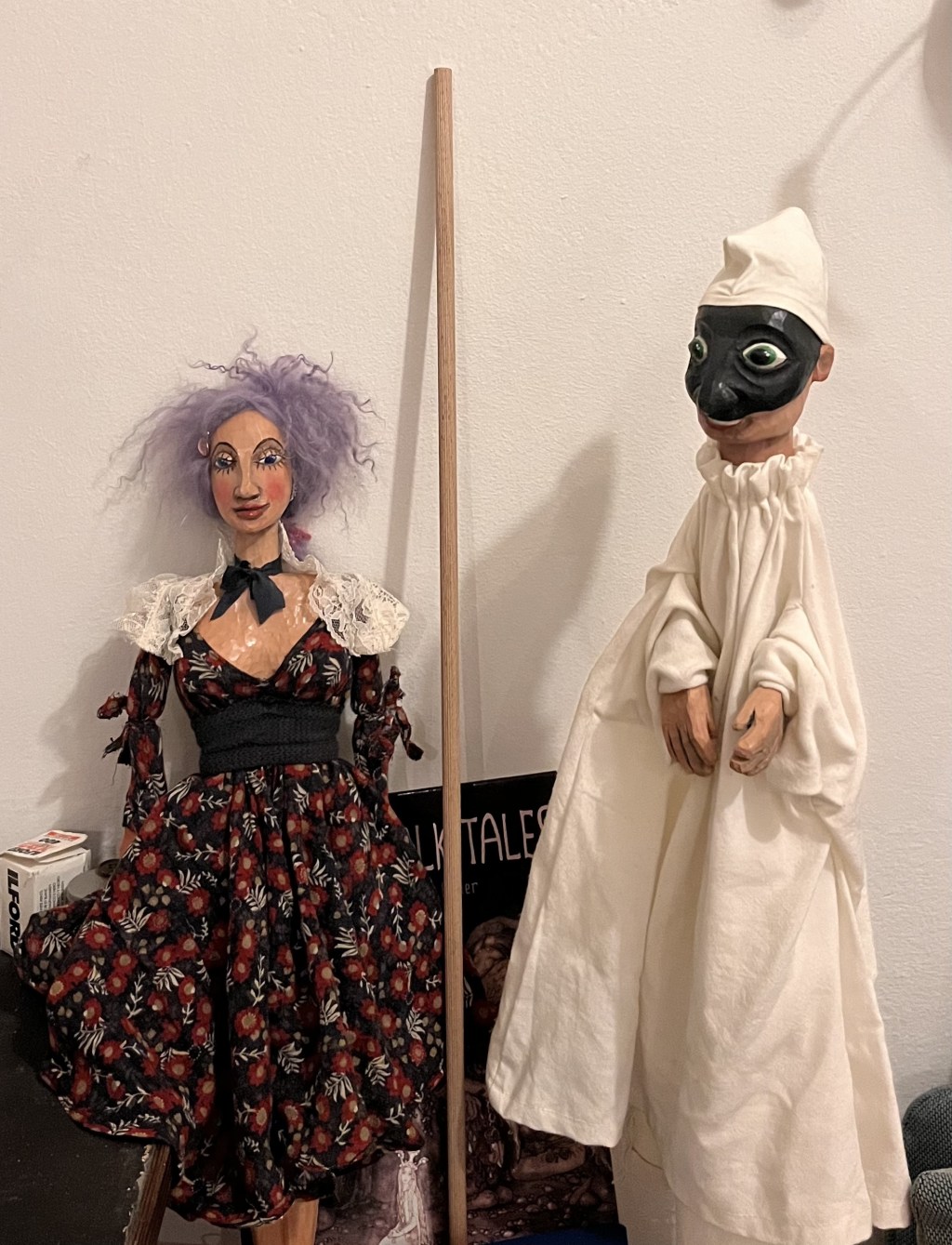
Let me tell you a secret: if I could only suggest one tip about puppetry, it would probably be rhythm of movement.
The way a puppet walks, stops, looks, reacts. Marionettes, hand puppets, rods, shadows, it doesn’t matter: if the rhythm is off, everything feels a bit dead; if the rhythm is right, even a scrap of fabric suddenly feels like it has a heartbeat.
Walking is where you feel this first. Beginners either slide the puppet like it’s on rails or make it jitter with no clear beat. What you want is a clean, simple pattern: step, step, step. Weight, transfer, release. And here’s the tiny trick that changes everything: start the walk before the puppet appears. Get the marionette walking behind the curtain, or bounce the hand puppet under the stage, and only then let it cross into view. If the first step happens after the entrance, the audience feels a bump. If it’s already mid-step, it feels like it came from somewhere and is going somewhere. Walking is half the story.
The other half is stopping. The pattern I use for almost everything is: move → stop → action → stop. Those pauses are punctuation. They give the audience a fraction of a second to understand each thought before the next one arrives. Take climbing a wall: one hand up — stop. Other hand up — stop. The puppet looks up — stop. Hand, stop. Hand, stop. Look, stop. Suddenly the audience climbs with the puppet because each piece of effort is clear and separated in time.
One more rule: the beak leads. The nose, snout, face, whatever it is, should point where the puppet is going. Change direction: first the beak turns and stops, then the body follows and stops, then it walks. That tiny delay reads as thought, as “I’ve decided to go over there now.” Start the walk before the entrance. Let the beak lead. Break big actions into small clear steps with little suspensions in between.
Watch your audience: if they’re following every gesture without squinting in confusion, you’ve found the pulse of your puppet and then you’re not dragging it around anymore, you’re dancing with it.


Rispondi